

Consumer Rights in India: Essential Legal Guide
Consumer rights in India protect buyers from unsafe products, defective goods, poor services, hidden charges, misleading claims, and unfair trade practices. The Consumer Protection Act, 2019 recognises six core rights and provides a three-level system for resolving eligible disputes.
These protections cover offline and online transactions. The result depends on consumer eligibility, evidence, filing deadlines, and the correct forum.
Meaning of Consumer Rights in India
The meaning of consumer rights is the legal protection given to buyers so they can make informed choices and seek fair remedies when businesses act wrongly. Consumer law helps buyers challenge unsafe goods, misleading advertisements, deficient services, and unfair terms controlled by businesses.
The main law is the Consumer Protection Act, 2019. It covers offline purchases and transactions made online, through teleshopping, direct selling, and multi-level marketing.
Consumer rights in India do more than provide refunds. They require businesses to share important information, avoid unsafe products, respect consumer choices, and respond fairly when something goes wrong.
Who Is Legally Considered a Consumer?
A person usually qualifies as a consumer when goods or services are obtained for consideration and used mainly for personal purposes rather than resale or commercial activity. Consideration may be paid, partly paid, promised, or payable later.
Approved users of goods and beneficiaries of services may also qualify. For example, a family member using a product bought with the purchaser’s permission may receive protection in suitable circumstances.
Purchases made for resale or a commercial purpose are generally excluded. However, an exception may apply when a person uses the goods exclusively to earn a livelihood through self-employment.
A tailor personally using one sewing machine may have a stronger consumer claim than a company buying several machines for employees. The outcome depends on how the goods are used, the scale of activity, and the purpose of the purchase.
Where consumer law does not apply, civil remedies may still exist. The guide on the difference between civil law and criminal law explains why the proper route depends on the dispute.
Types of Consumer Rights Under Indian Law

The types of consumer rights cover safety, truthful information, freedom of choice, fair hearing, effective redressal, and awareness of available legal protection. These protections apply at different stages of a transaction.
| Consumer right | What it protects |
|---|---|
| Right to safety | Protection against hazardous goods and services |
| Right to be informed | Accurate details about quality, price, quantity, standards, and risks |
| Right to choose | Access to alternatives without forced selling |
| Right to be heard | Fair consideration of consumer complaints |
| Right to seek redressal | Repair, replacement, refund, compensation, or corrective action |
| Right to consumer awareness | Knowledge needed to identify unfair practices |
These rights often overlap. False discounts affect information rights, dangerous appliances raise safety concerns, and refusal to honour a valid warranty may support redressal.
Consumer awareness and consumer rights are closely connected. A valid claim becomes harder to prove when the buyer has no invoice or cannot show what the seller originally promised.
Legal Protection to Consumers and Available Remedies
Legal protection to consumers applies to defective goods, deficient services, misleading advertisements, overcharging, hazardous products, unfair trade practices, and certain unfair contracts. The available remedy depends on the facts and supporting documents.
A consumer commission may order:
- Repair of the product or correction of the service;
- Replacement of defective goods;
- Refund of the amount paid;
- Compensation for proven loss or injury;
- Discontinuation of an unfair trade practice;
- Withdrawal of hazardous goods;
- Corrective advertising;
- Payment of suitable legal costs.
The commission examines invoices, contractual terms, correspondence, proof of loss, and the connection between the business failure and the harm claimed. A refund or compensation is not automatic merely because the consumer is dissatisfied.
Product liability may arise when a defective product causes harm because of manufacturing, design, inadequate warnings, poor service, or seller conduct. Injury claims usually need medical records, photographs, expert material, and clear proof connecting the defect with the damage.
The Central Consumer Protection Authority can also address violations affecting consumers as a class, including misleading advertisements and wider unfair trade practices.
How to Enforce Consumer Rights in India
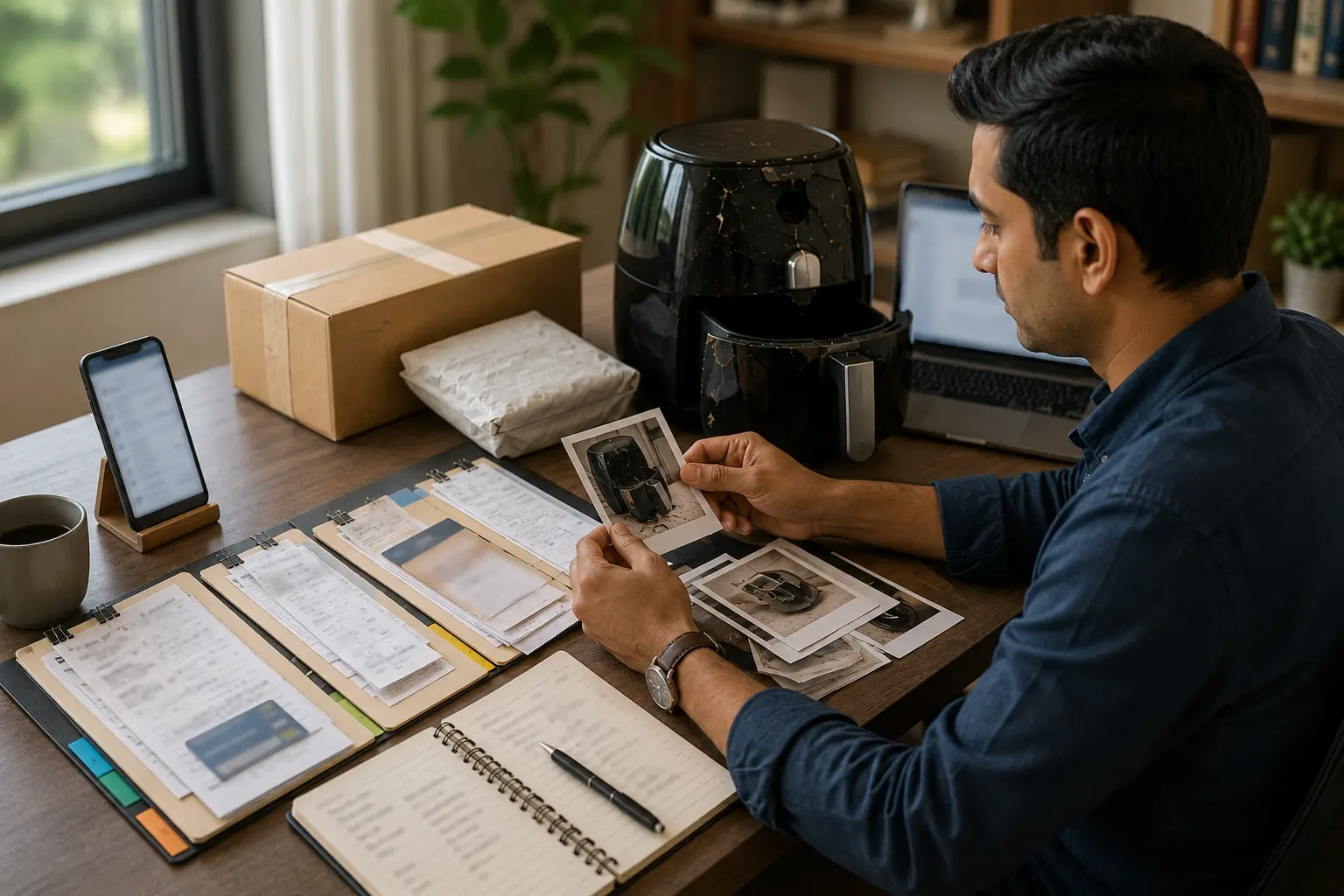
A strong consumer claim starts with a clear timeline, complete evidence, a specific demand, and timely escalation through the correct grievance channel. Consumers should avoid relying only on telephone conversations.
First, contact the seller or service provider in writing. State what was purchased, when the transaction occurred, what went wrong, and the remedy expected.
Preserve the following evidence:
- Invoice, payment receipt, and order confirmation;
- Advertisement, product description, and warranty;
- Emails, chats, complaint numbers, and delivery records;
- Photographs, videos, repair reports, or medical documents;
- Proof of financial loss and earlier refund requests.
A formal notice can help when ordinary complaints are ignored. Readers may refer to what a legal notice is before sending one.
A private lawyer’s notice differs from an official notice issued after proceedings begin. This distinction is explained in the guide on the difference between a lawyer notice and court notice.
Consumers may approach the National Consumer Helpline before litigation. Complaints can be registered through its portal and supported channels, including helpline number 1915.
The National Consumer Helpline may support an early resolution by forwarding the complaint to participating organisations. However, it does not replace a binding order from a consumer commission. If the matter remains unresolved, a formal complaint may be filed through e-Jagriti or before the appropriate commission. Consumers may appear personally, although legal assistance can help with complex or high-value claims.
Consumer Commission Jurisdiction and Filing Deadline

The correct consumer commission generally depends on the consideration paid for the goods or services, not simply on the amount of compensation demanded. Using the wrong forum may delay the complaint.
Under the Consumer Protection jurisdiction rules notified in 2021:
- District Commission: consideration paid up to ₹50 lakh
- State Commission: above ₹50 lakh and up to ₹2 crore
- National Commission: above ₹2 crore
A consumer may also be able to file where they reside or personally work for gain, subject to territorial requirements. Several invoices, joint claims, or mixed personal and commercial use may require closer legal review.
A consumer complaint should normally be filed within two years from the date on which the cause of action arose. A delayed complaint may be accepted when sufficient cause is shown, but acceptance is not guaranteed.
Repeated customer-care promises do not always protect the filing deadline. Consumers should record the purchase date, delivery date, date of defect, refund refusal, and later written responses.
Consumer Awareness and Consumer Rights Online

Online consumers receive the same basic protection, but digital transactions create added risks because prices, consent screens, product descriptions, and cancellation options can change quickly. Screenshots can become important evidence.
Warning signs include:
- Paid add-ons placed in the basket without consent;
- False countdown timers or scarcity claims;
- Charges disclosed only at checkout;
- Subscriptions that are difficult to cancel;
- Confusing buttons that encourage a costly choice;
- Advertisements presented as neutral information.
These methods are commonly called dark patterns. Government guidance identifies practices such as false urgency, basket sneaking, confirm shaming, subscription traps, drip pricing, disguised advertisements, and forced action.
Save screenshots before and after payment. Keep the product page, final checkout amount, cancellation terms, invoice, and customer-support messages because online evidence may later change or disappear.
Consumer Responsibilities That Strengthen a Claim
Consumer rights and awareness education works best when buyers verify important details, request invoices, read key terms, and report problems without delay. Responsible conduct also makes the complaint easier to prove.
Before paying, check the seller’s identity, final price, warranty, expiry date, return policy, safety certification, and grievance contact. Avoid relying only on verbal promises for costly goods or long-term services.
After a problem appears, stop using an unsafe product when continued use may increase damage. Preserve the item for inspection, protect electronic records, and make a reasonable written demand supported by proof.
Consumers should avoid exaggerating their loss. A realistic remedy supported by documents usually carries more weight than a large compensation claim without evidence.
Prashastha Legal Take
The strongest consumer complaints connect the original promise, payment, product defect or service failure, complaint history, resulting loss, and requested remedy. Every document should support one of these points.
Claims become difficult when dates and documents remain scattered. A short chronology supported by invoices, screenshots, reports, and written follow-ups presents the dispute more clearly.
A routine refund may resolve through customer support or the National Consumer Helpline. Builder disputes, insurance rejection, medical negligence, product injury, or high-value service failures may need detailed legal review.
Matters outside consumer jurisdiction may require assistance from civil lawyers in Bangalore, while eligible disputes can be reviewed by experienced consumer lawyers in Bangalore.
Conclusion
Consumer rights in India protect buyers against unsafe goods, deficient services, misleading information, unfair selling, and denial of reasonable remedies. They work best when consumers act early, preserve evidence, and choose the correct forum.
Prashastha Legal can review consumer eligibility, documents, jurisdiction, limitation, and suitable relief. Early legal assessment can prevent weak claims, missed deadlines, and unnecessary proceedings while supporting a practical resolution.
FAQs About Consumer Rights in India
These FAQs explain the meaning of consumer rights, complaint procedures, online purchases, and legal protection to consumers in simple language. The answers are structured for quick reading and voice-search queries.
1. What are the main consumer rights in India?
The main consumer rights are safety, information, choice, being heard, redressal, and consumer awareness.
2. Who can file a consumer complaint in India?
Eligible buyers, approved users, service beneficiaries, legal heirs, and recognised consumer associations may file consumer complaints.
3. Can I complain against an online shopping platform?
Yes. Consumer law covers online transactions. Liability depends on the roles of the seller, manufacturer, service provider, and platform.
4. Is a legal notice compulsory before filing a consumer case?
Usually, no. However, a notice can record the demand and give the business a final opportunity to settle the dispute.
5. What is the time limit for filing a consumer complaint?
The normal filing period is two years from the cause of action. A delay requires a satisfactory explanation accepted by the commission.
6. Do I need a lawyer for a consumer complaint?
No. Consumers may file and appear personally. Legal help can assist with jurisdiction, evidence, complex contracts, or substantial compensation.
7. What documents are needed for a consumer complaint?
Keep invoices, payment proof, warranties, advertisements, photographs, emails, chats, complaint numbers, reports, and documents proving the loss.
