

Hidden Property Registration Charges in Bangalore and Process
Property registration charges in Bangalore can look simple at first, but buyers often miss extra costs, document requirements, and process-related issues that affect the final amount. This guide explains property registration charges in Bangalore, the property registration process in Bangalore, what is property registration, and when to consult property registration lawyers in Bangalore before you sign.
Property Registration Charges in Bangalore: The Answer First
Property registration charges in Bangalore usually come from four heads: stamp duty, additional stamp duty, surcharge in many urban areas, and registration fee. For a standard sale deed or conveyance in Karnataka, stamp duty is generally 5% of the property’s market value. The law also adds an additional duty equal to 10% of the stamp duty amount. In many Bengaluru urban limits, the surcharge is 2% of the stamp duty. Separately, the registration fee for a conveyance is currently 2% of the market value.
So, for many buyers inside Bengaluru’s urban limits, it is practical to budget around 7.6% of the market value toward government charges, plus minor scanning and service charges. That estimate comes from 5% stamp duty, 0.5% additional duty, 0.1% surcharge, and 2% registration fee. The total can change when you qualify for a reduced stamp duty slab, mainly in certain first-sale flat transactions, or when the document is not a standard sale deed.
Stamp Duty and Registration Fee Laws That Set the Charges
Understanding the legal basis behind property registration charges in Bangalore helps buyers avoid confusion and spot incorrect advice early.
- The Karnataka Stamp Act, 1957 and its Schedule fix the stamp duty rate for conveyance at 5% of the market value.
- The same Act also levies additional duty on conveyance and similar instruments at 10% of the stamp duty amount.
- For many Bengaluru properties, the Karnataka Municipal Corporations Act, 1976 adds a surcharge on transfer of immovable property in larger urban areas, calculated as 2% of the stamp duty.
- The Department of Stamps and Registration fee chart currently lists the registration fee for a conveyance at 2% of the market value.
A Quick Calculation Table
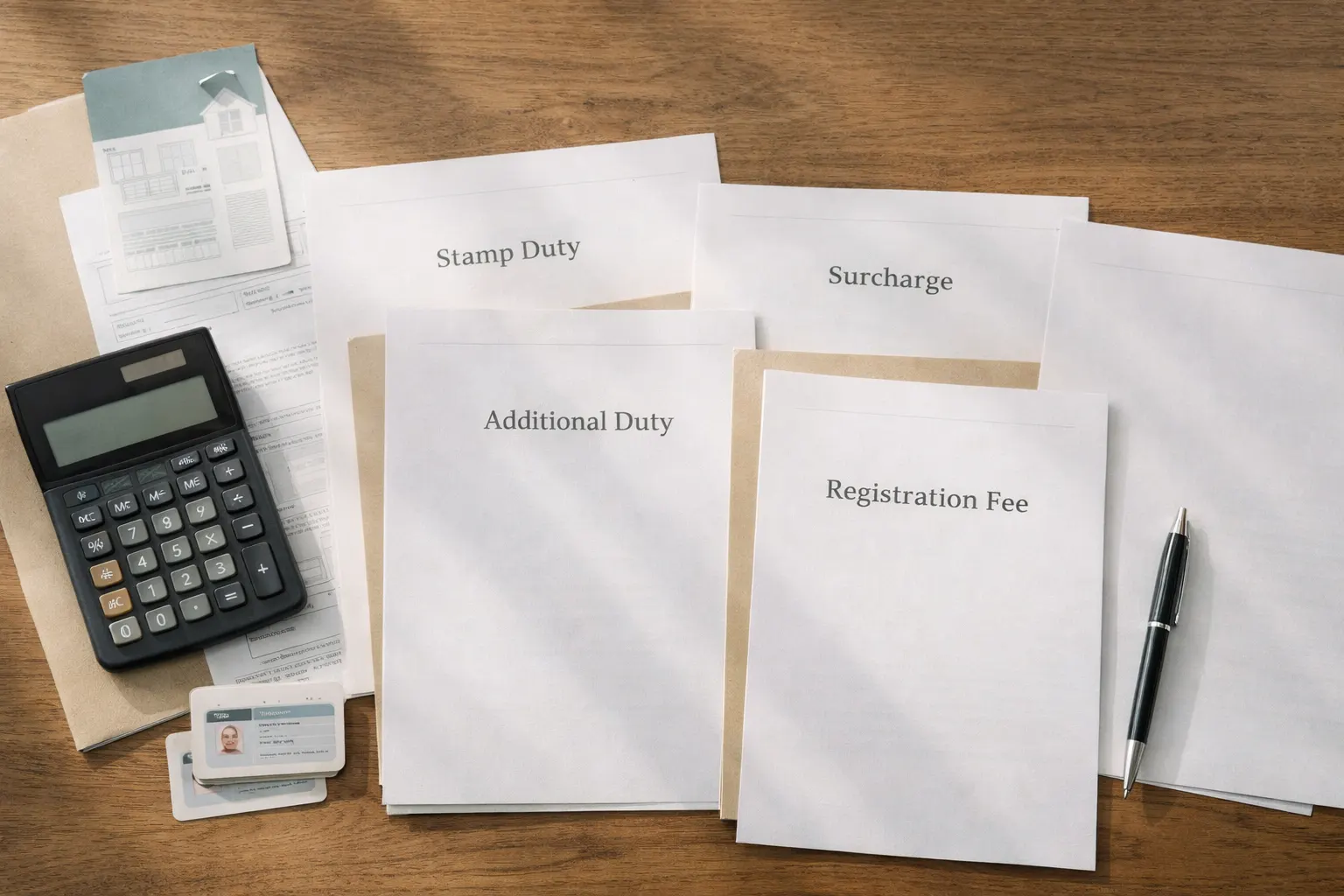
Use this table to estimate property registration charges in Bangalore before signing the deed. It gives you a practical budgeting reference and reduces last-minute surprises.
| Cost head (sale deed) | Rate | How it is applied |
|---|---|---|
| Stamp duty | 5% | On market value |
| Additional duty | 10% of stamp duty | Adds 0.5% on value when stamp duty is 5% |
| Urban surcharge (where applicable) | 2% of stamp duty | Adds 0.1% on value when stamp duty is 5% |
| Registration fee | 2% | On market value |
Example on ₹50,00,000 market value: stamp duty ₹2,50,000, additional duty ₹25,000, surcharge ₹5,000, and registration fee ₹1,00,000. Total: ₹3,80,000, or 7.6%, before minor charges.
Property Registration Charges in Bangalore: When Costs Change

Property registration charges in Bangalore do not remain the same in every transaction. A few common situations can change the final amount.
First sale of certain flats can reduce stamp duty
The Karnataka Stamp Act provides a special slab for the first sale of a flat or apartment up to certain market value thresholds. Broadly, this may allow:
- Up to ₹20 lakh: 2% stamp duty
- ₹20 lakh to ₹35 lakh: 3% stamp duty
- ₹35 lakh to ₹45 lakh: 3% stamp duty
- Above the applicable slab threshold: regular rate applies
This benefit should not be assumed for resale flats. The document type and the nature of the transaction must match the law.
Not every transfer is a sale deed
A gift deed, partition deed in Bangalore, Karnataka, release deed, settlement deed, exchange deed, and some powers of attorney follow different stamp duty entries. Karnataka also allows concessional duty for some close-family transfers, but only when the relationship and conditions fit the law. Choosing the wrong instrument just to save money can create future legal problems.
Undervaluation disputes can add cost and delay
If the value stated in the document appears lower than the department’s estimate, the office can act under Section 45-A of the Karnataka Stamp Act and the Karnataka Stamp (Prevention of Undervaluation of Instruments) Rules, 1977. The officer may keep the registration pending and demand deficit stamp duty and deficit registration fee. Buyers can reduce this risk by checking the guidance value early and ensuring the deed is drafted properly.
What Is Property Registration and Why Does It Matter?
What is property registration? It is the official government process of recording a document that transfers rights in immovable property.
Under Section 17 of the Registration Act, 1908, sale deeds require compulsory registration.
Under Section 54 of the Transfer of Property Act, 1882, a sale of immovable property is completed through a registered instrument.
This is not just a formality. Proper registration protects ownership, supports future bank loans, and reduces the chance of disputes during resale, inheritance, or family claims.
Property Registration Process in Bangalore

This checklist keeps your property registration charges in Bangalore accurate and avoids last-minute surprises.
1. Do a title and EC check
Review parent deeds and take an Encumbrance Certificate (EC) in Karnataka. Confirm loans, attachments, and pending cases.
2. Confirm market value and guidance value
Compare your agreed price with the guidance value (Revised Guidelines Value). Budget based on the higher figure to reduce undervaluation risk.
3. Draft the sale deed in Karnataka carefully
Use the correct schedule, boundaries, survey details, and UDS details for flats. Fix mistakes before the appointment.
4. Pay stamp duty and fees
Use Kaveri Online Services (Kaveri 2.0) for payment and slot booking where applicable. Keep payment references ready.
5. Register at the Sub-Registrar Office
Try to present the deed within four months of execution. Late presentation can attract extra costs and delays. Buyer, seller, and witnesses attend, complete biometrics, sign, and finish registration.
6. Update records after registration
Apply for a khata transfer or mutation of property in Karnataka and update property tax records. If Khata is confusing, understand the difference between A Khata and B Khata before you proceed.
Documents required for property registration in Bangalore

Most Bengaluru registrations need these basics. When you keep them ready, you reduce re-visits and keep property registration charges in Bangalore from changing at the counter:
- Sale deed draft/final
- ID proof and address proof of the buyer, seller, and witnesses
- Parent deeds and link documents
- EC, khata, and the latest tax paid receipt
- Approvals/NOCs if your property category requires them
- Form 1 and affidavit under the undervaluation rules when the office asks
My 20-year view on saving money
In my experience, buyers lose far more money in property disputes in Bangalore than they ever save by trying to understate value. The safer strategy stays simple: buy a clean title, pay the correct duty, and keep a clear banking trail.
If you want to prevent trouble, focus on approvals and title chain, not shortcuts on stamp duty. You can recover from paying a little extra. You cannot easily recover from buying a title that does not hold up.
When to involve property registration lawyers in Bangalore

You should involve property registration lawyers in Bangalore when you see:
- missing link deeds, multiple owners, NRIs, or minors
- conversion or layout approval issues
- Power of attorney for property in Bangalore, signing, or the seller is not available to attend
- prior mortgages, attachments, or court disputes
- builder projects where UDS and approvals need checking
Prashastha Legal’s property lawyers in Bangalore support clients with title verification, drafting, and registration guidance with a dispute-prevention mindset.
Frequently Asked Questions About Property Registration Charges in Bangalore
1) What are the property registration charges in Bangalore for a sale deed?
In many Bengaluru urban areas, buyers usually budget about 7.6% of the market value, plus minor charges. First-sale flat slabs and other documents can differ.
2) Is the registration fee in Bangalore 1% or 2%?
For a conveyance, the current government fee chart shows a registration fee as 2% of the market value. Always verify on the latest department fee chart.
3) What is the property registration process in Bangalore?
You verify the title, check the guidance value, draft the deed, pay through Kaveri, and register at the Sub-Registrar Office with witnesses and biometrics.
4) Can the Sub-Registrar increase my stamp duty amount?
Yes. If the office finds undervaluation, it can act under Section 45-A and the undervaluation rules and demand the deficit duty and fee.
5) What documents are required for property registration in Bangalore?
Usually: sale deed, ID proofs, parent deeds, EC, khata and tax receipts, and approvals/NOCs if applicable. The office may also ask for Form 1 and an affidavit.
6) Do I need a lawyer for property registration in Bangalore?
Not always. But a lawyer helps when the title is complex, approvals look weak, or you want to avoid future disputes.
Get clarity on costs before you register
If you worry about hidden costs, undervaluation notices, or unclear title, speak to Prashastha Legal before you sign or pay a big token. We will review your papers, explain your exact property registration charges in Bangalore, and help you avoid add-ons that inflate property registration charges in Bangalore, while guiding you through a clean registration that protects your ownership.