

Partition Deed: Critical Guide for Bangalore Families
A partition deed is a written legal document that divides a jointly owned property into fixed shares and gives each co-owner a separate title over their allotted portion. It ends joint ownership and replaces it with clear, individual ownership.
In Bangalore, a partition deed helps families avoid common pain points such as property disputes in Bangalore, blocked sales, loan issues caused by unclear title, and delays in record updates. When the document itself divides immovable property, registration is generally compulsory, and a registered instrument is far easier to use before the Sub-Registrar, revenue authorities, and courts.
One-line takeaway: Register it to make the division usable.
What the law says (and why it matters)
This section covers the two legal points that decide whether your partition will hold up in real life: first, registration, which makes the document legally usable for title and future transactions; and second, stamp duty and registration fees, which must be paid correctly to avoid objections later. The goal here is practical clarity, not legal jargon.
Registration makes the division legally usable

The Registration Act, 1908, Section 17 requires registration of non-testamentary documents that create, declare, assign, limit, or extinguish rights in immovable property valued at ₹100 or more. A partition deed usually does exactly that because it declares each person’s separate share and brings the earlier joint right to an end.
If a document that requires registration is left unregistered, Section 49 of the Registration Act creates a serious practical problem. Such a document generally cannot affect the property or be received as evidence of the transaction, except for limited collateral purposes. In simple terms, the document may fail when you need it most. Karnataka’s own registration guidance also states that if partition is effected through an instrument, that instrument must be compulsorily registered.
Karnataka follows a fixed, per-share stamp duty for partition deeds

The current Karnataka Department of Stamps and Registration fee page lists partition deed stamp duty and registration fees on a per-share basis. For non-agricultural converted property in BBMP, Municipal Corporation, Urban Development Authority, Municipal Council, or Town Panchayat areas, the department currently lists ₹5,000 stamp duty per share and ₹1,000 registration fee per share. For other non-agricultural converted properties, it lists ₹3,000 stamp duty per share and ₹500 registration fee per share.
Agricultural land is listed at ₹1,000 stamp duty per share and ₹200 registration fee per share, while movable property is listed at ₹1,000 stamp duty per share and ₹300 registration fee per share.
This quick table is meant to improve clarity before you draft. Because government fee schedules can change, always confirm the latest slabs on the Karnataka Department of Stamps & Registration fee table before execution.
| Property type (Karnataka) | Stamp duty per share | Registration fee per share |
|---|---|---|
| Non-agricultural (converted) property in municipal areas, including BBMP / city corporation / UDA / municipal council / town panchayat | ₹5,000 | ₹1,000 |
| Non-agricultural (converted) property in other areas | ₹3,000 | ₹500 |
| Agricultural land | ₹1,000 | ₹200 |
| Movable property or money | ₹1,000 | ₹300 |
How to read “per share”: if four family members are each allotted a separate share, the department’s fee table is ordinarily applied share-wise.
Courts draw a clear line on “does this writing itself divide the property?”
In practice, the legal line is simple:
- If the writing is only a record or memorandum of an already completed oral partition, the registration position may be different.
- If the writing itself effects the division of immovable property, registration is usually required.
That distinction flows directly from Section 17 of the Registration Act and is also reflected in Karnataka’s official registration guidance, which distinguishes between a partition effected through an instrument and an oral partition recorded later in a memorandum. This is exactly why wording matters. One loose sentence can change the legal character of the document.
When a partition deed may not be the best option
A partition deed works best when everyone agrees on shares and wants a clean, future-proof title for each person. But some situations call for a different route because the facts, family dynamics, or existing documents can change what is legally safer. These are the common scenarios where a partition deed may not be the right first step.
Partition deed vs family settlement
A family settlement is sometimes used to preserve peace within the family. But the drafting test remains important: if the written document itself is intended to create, declare, assign, limit, or extinguish rights in immovable property, registration risk comes into play under Section 17 of the Registration Act.
A safe approach in most Bangalore family matters is simple:
- If you want the writing to be the main proof of the division, register it.
- If you want to rely on an already completed oral arrangement, get the draft vetted carefully before you decide.
Partition deed vs release deed
Use a partition deed when all co-owners are receiving a separate portion or a defined separate share.
Use a release deed when one co-owner is giving up their share in favour of another co-owner.
Choosing the wrong document often creates avoidable problems later during title verification, loan processing, mutation, and resale.
Ancestral property vs jointly purchased property
The source of the property changes the legal analysis. Before drafting, confirm the legal owners and verify whether there is any prior will, gift deed, settlement deed, or earlier family arrangement affecting title.
If a co-owner has passed away, sort out succession first. This guide on transfer of joint property on death explains the usual routes families use before they sign any partition deed.
If the matter is already in court
If family members cannot agree, they may have to file a partition suit. The Partition Act, 1893 recognizes the court’s power to order sale instead of physical division in appropriate cases, and Order XX Rule 18 of the Code of Civil Procedure, 1908 deals with decrees in partition suits and separate possession matters.
If your concern is a divorce-linked split rather than a family partition, see our guide on division of property after divorce to understand how ownership and claims usually play out.
How to draft and register a partition deed in Bangalore

This is the practical workflow most Bangalore families follow when they want a legally clean, registration-ready partition deed. The objective is simple: confirm ownership, record a clear allotment, pay the correct partition deed stamp duty and partition deed registration charges, and then complete the related record updates so your individual share is easier to deal with later.
Step 1: Verify the title and current records
Collect the title deed, Encumbrance Certificate (EC), Khata or RTC, tax receipts, and identity proofs for all parties.
Step 2: Decide the share and the exact allotment
A good partition deed answers the practical questions, not just the legal ones. It should clearly state the allotment, boundaries, PID / Khata / survey number details, common rights such as passage, parking, or terrace use, and responsibility for pending dues. Where possible, describe each portion by clear boundaries and measurements.
Step 3: Calculate fees and register
In Karnataka, partition deed stamp duty and registration charges are commonly listed on a per-share basis and vary by property category and location. Use the current department fee table before you finalise the draft. For online preparation and registration workflow, begin with Kaveri Online Services (Document Registration). Karnataka’s official registration guidance also states that where partition is effected through an instrument, the instrument must be registered.
Step 4: Do the post-registration updates
Registration alone is not the end of the process. Follow through with mutation or Khata transfer, revenue record updates where applicable, and a fresh EC after indexing so the division appears in official records and not just in your private paperwork. Karnataka’s service portals separately provide document registration, encumbrance certificate services, and change-of-Khata workflows. See difference between A Khata and B Khata.
The one mistake that keeps coming back
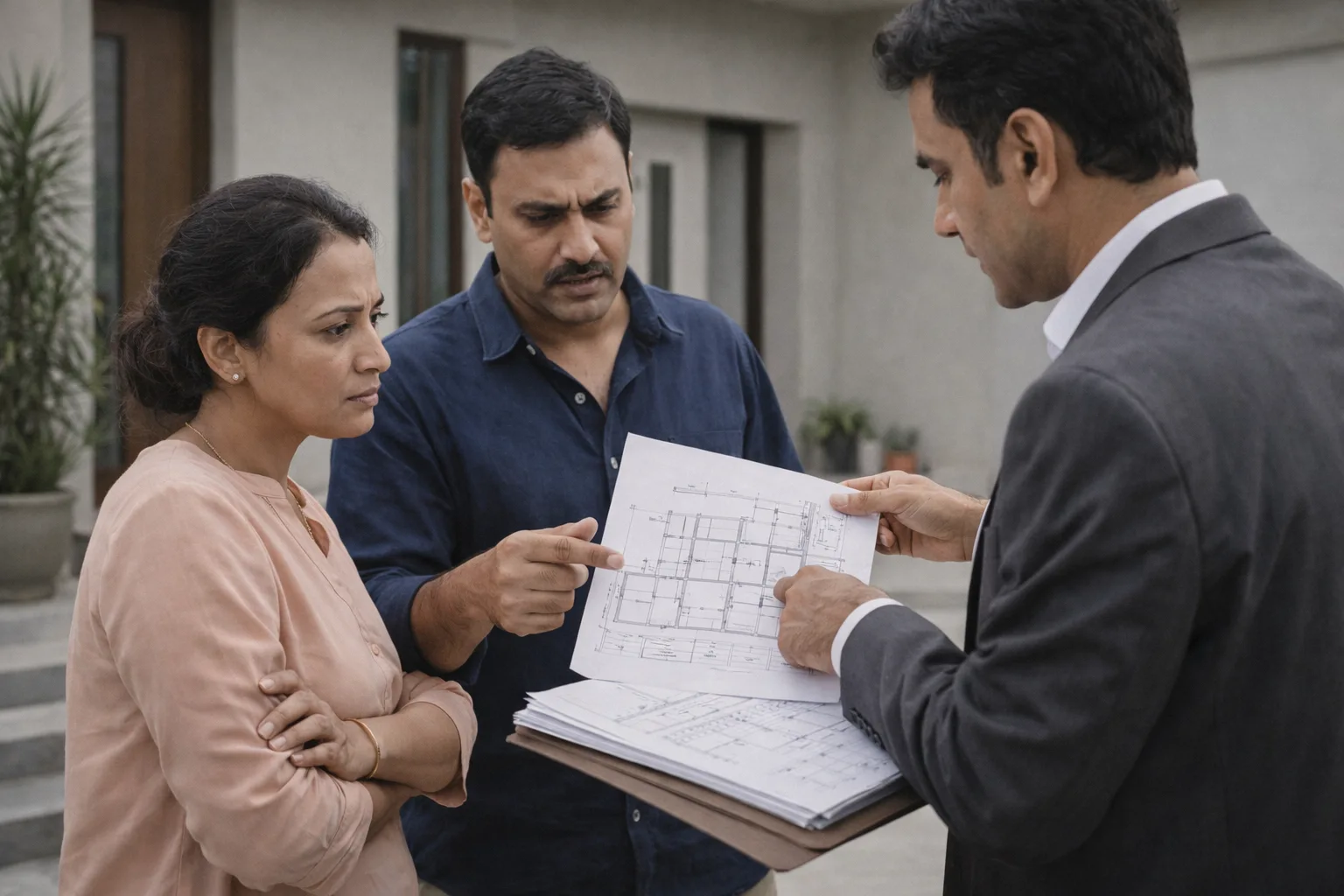
Most families focus only on saving stamp duty. They miss the bigger risk: an unclear property description and vague shared-use rights.
Disputes often restart because the deed does not clearly deal with common areas and practical use. Parking becomes a fight. Terrace access becomes a fight. Even a water connection becomes a fight. The deed should be drafted so clearly that a stranger can read it and understand ownership without calling your family for an explanation.
If you invest in clarity now, you usually save years of emotional and legal damage later.
Why partition deeds matter more in Bangalore now
Bangalore real estate moves fast, and almost every future transaction depends on clean title documents. A properly drafted and registered partition deed makes it easier to show separate ownership for each allotted share and makes future sale, mortgage, inheritance, and municipal record updates smoother.
Frequently Asked Questions About Partition Deeds in Bangalore and Karnataka
1) What is partition deed?
A partition deed is a legal document that divides jointly owned property into defined shares and gives each person separate ownership over the portion allotted to them.
2) Is registration compulsory for a partition deed?
Usually yes, if the deed itself creates or declares rights in immovable property. Non-registration can make the document unusable for proving partition except in limited collateral situations.
3) Can we do partition without registration?
An oral arrangement may exist in some families, but proving it later can be difficult. For valuable immovable property, a registered deed is usually the safest and cleanest route.
4) What are partition deed registration charges in Karnataka?
The Karnataka Department of Stamps and Registration currently lists registration fees per share, varying by the property category and location. For many non-agricultural converted properties in municipal-area categories, the listed registration fee is ₹1,000 per share.
5) What is the partition deed stamp duty in Karnataka?
Karnataka’s current department fee page lists stamp duty for partition deeds on a per-share basis. For many non-agricultural converted properties in BBMP and similar municipal-area categories, the listed stamp duty is ₹5,000 per share.
6) Is an unregistered partition deed valid in court?
If the document required registration, Section 49 says it generally cannot be received as evidence of the transaction affecting immovable property, except for limited collateral purposes.
7) Partition deed vs family settlement: which is better?
A family settlement can be flexible, but if the written document itself creates rights in immovable property, registration issues may arise. A registered partition deed is usually clearer for future title-based transactions.
8) Can a partition deed be cancelled?
It depends on the facts. If all parties agree, they may execute a fresh corrective or cancellation arrangement where legally appropriate. If there is a dispute, court intervention may be required.
Talk to Prashastha Legal
If you are facing pressure from family members, missing documents, or fear of future disputes, do not sign a rushed draft. Prashastha Legal helps Bangalore families draft, register, and update records for partition deeds with clear shares and clean property descriptions. If you want an advocate-led review before you sign, speak to our property lawyers in Bangalore or use the contact page to book a consultation.
Consult us early. A careful partition deed today can save years of litigation and stress tomorrow.